
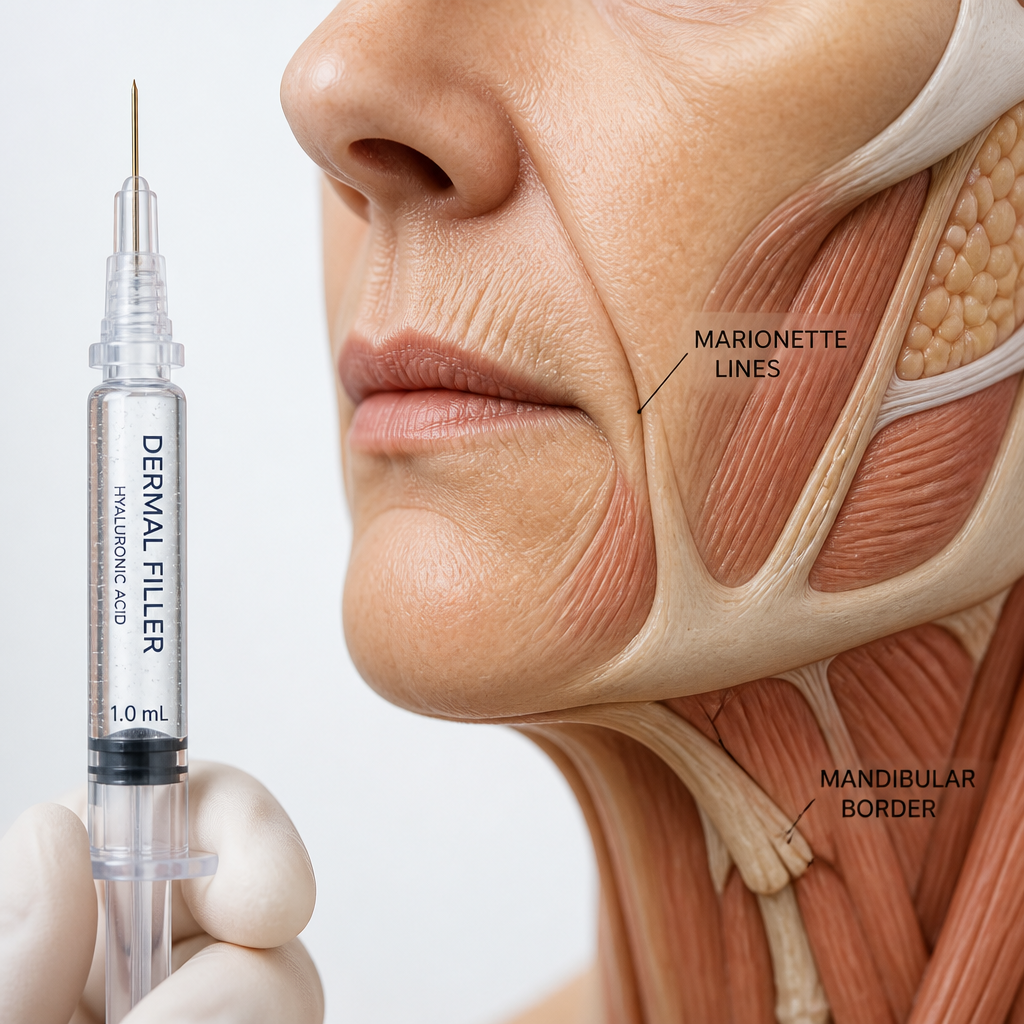
Most people who come to Skin Excellence Medispa asking about marionette lines in Aurora describe the same frustration: they look tired or sad even when they feel perfectly fine. Those downward-pulling creases from the corners of the mouth toward the chin do exactly that, and they tend to deepen faster than people expect once they start forming. Dermal fillers are the most requested solution, and for good reason. But they are not a fix for every presentation of this concern. Understanding what fillers genuinely accomplish, where they fall short, and how a skilled injector approaches the lower face makes the difference between a result that looks natural and one that looks off.
Table of Contents
- Quick Takeaways
- What Actually Causes Marionette Lines
- What Fillers Can Do for Marionette Lines
- What Fillers Cannot Do
- Filler Types Compared: Choosing the Right Product
- Why Injector Technique Matters as Much as Product Choice
- Combining Fillers with Other Treatments
- Frequently Asked Questions
- References
Quick Takeaways
| Key Insight | Explanation |
|---|---|
| Marionette lines are structural, not just skin-deep | They result from volume loss, ligament laxity, and soft tissue descent, not simply surface wrinkling. Filler addresses volume but not tissue repositioning. |
| Filling the line directly is often the wrong approach | Skilled injectors treat the structural causes, including the lateral cheek and jawline, rather than packing product directly into the crease. |
| Hyaluronic acid fillers deliver immediate, reversible results | Products like Juvéderm Vollure and Restylane Defyne are well-suited to the motion-heavy lower face and can last roughly 6 to 12 months in this area. |
| Sculptra builds results over months, not days | As a collagen stimulator, Sculptra gradually restores volume and can provide longer-lasting structural support than HA fillers, though results take weeks to appear. |
| Fillers cannot replace a surgical lift for significant laxity | Heavy jowling and significant skin sagging require more than filler. A good injector will tell you this honestly rather than over-fill and distort proportions. |
| The number of syringes needed varies by anatomy | Most patients addressing marionette lines need between one and four syringes depending on severity, facial structure, and whether adjacent areas are also treated. |
| Combining treatments improves outcomes for moderate cases | Pairing filler with skin-tightening options such as micro-needling or PRP/PRF therapy addresses both volume loss and skin quality for more comprehensive results. |
What Actually Causes Marionette Lines
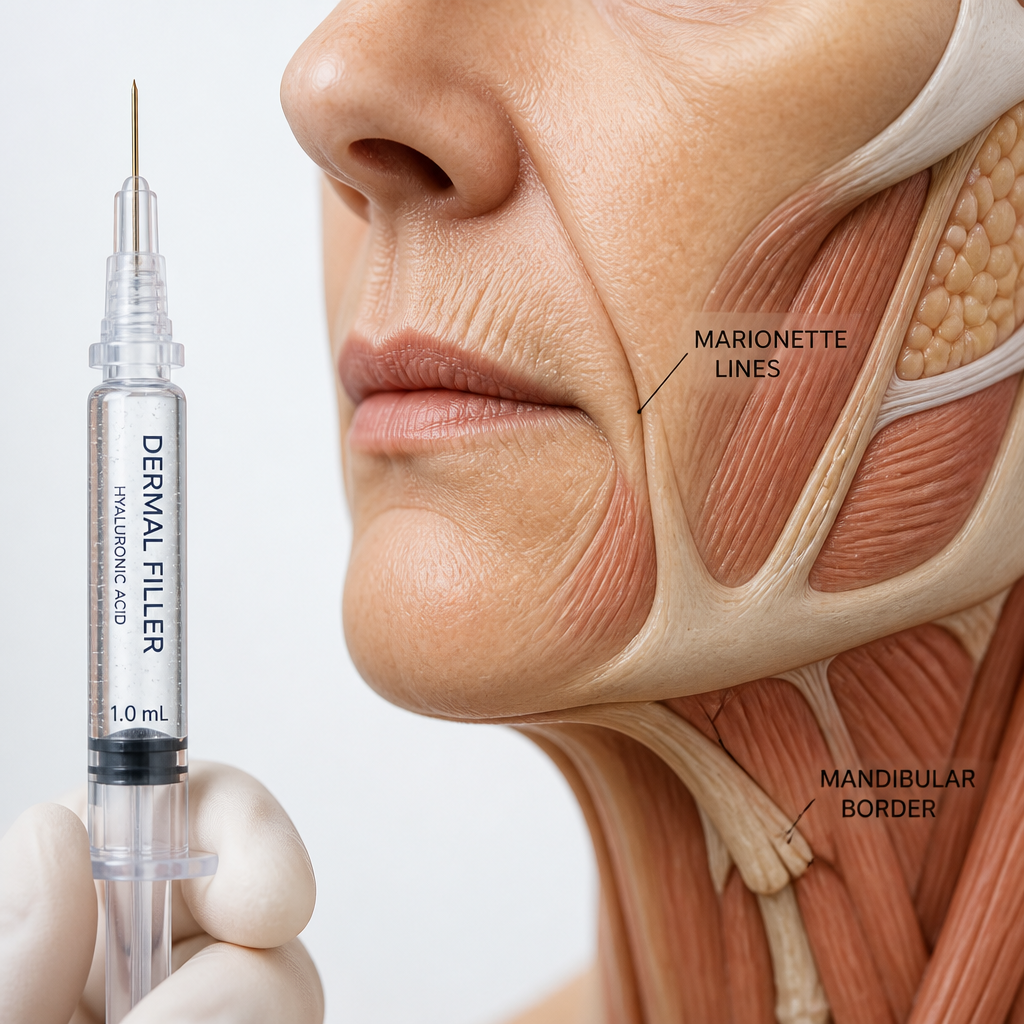
Marionette lines are the vertical folds that run from the corners of the mouth downward toward the chin, mimicking the hinged jaw of a puppet. They are not a single aging event but the visible result of several changes happening at once: loss of facial fat pads, weakening of the retaining ligaments that hold soft tissue in place, reduced bone density in the lower jaw, and the gradual downward migration of cheek volume. Repeated muscle activity around the mouth accelerates the folding over time.
Factors like sun exposure, smoking, genetics, and significant weight changes all influence how early and how deeply these lines develop. Patients in their late thirties can already see the early stages, particularly if they have a naturally lean face or a history of significant sun exposure.
The key anatomical point is that the crease itself is a symptom of what is happening above and around it. Cheek volume descends, the marionette ligament holds the skin down at the corner of the mouth, and the tissue between those two anchoring points folds. Any treatment plan that ignores the structural causes and treats only the visible crease will produce a short-lived or unnatural result.
Other contributing causes include collagen and elastin loss that reduces the skin’s ability to rebound, as well as the natural thinning of subcutaneous fat that occurs with age. Patients who have lost significant body weight often notice a disproportionate deepening of marionette lines because fat loss in the face accelerates the structural collapse.

What Fillers Can Do for Marionette Lines
When the presentation is mild to moderate, dermal fillers genuinely deliver meaningful improvement. The mechanism is straightforward: restoring lost volume in and around the marionette crease reduces the depth of the fold, softens shadowing, and lifts the corner of the mouth back toward a more neutral position.
Immediate Softening of the Crease
Hyaluronic acid fillers produce visible results the same day. The fold becomes shallower, the downturned appearance at the mouth corners is reduced, and the overall lower face looks less fatigued. For many patients at Skin Excellence Medispa in Aurora, this is the result they have been wanting to achieve for years without resorting to surgery.
Structural Support to the Lower Face
A well-executed lower face filler treatment does more than fill a single crease. By placing product along the jawline, in the prejowl area, and in the lateral cheek, an experienced injector creates a scaffolding effect that lifts sagging tissue away from the marionette fold. This approach treats the root cause, not just the surface symptom, and tends to produce a more natural, balanced appearance.
Restoration of Facial Proportions
Volume loss in the midface and lower face disrupts the triangular shape associated with youth. Fillers, when placed strategically across the lower face, can restore some of that proportional balance. The improvement is not just about the crease itself but about the overall reading of the face at rest.
Pro tip: Ask your injector to assess your cheeks and jawline at the same consultation. Marionette lines almost always have a midface or lateral face component that, when treated, reduces how much product is needed directly in the fold itself.
What Fillers Cannot Do
This is the part most patients do not hear clearly enough before their first appointment, and it matters. Setting accurate expectations is not pessimism; it protects you from over-treatment and disappointment.
Fillers Cannot Lift Significantly Descended Tissue
When soft tissue has descended substantially, creating heavy jowling and a pronounced marionette fold, filler can soften the appearance only modestly. Trying to fully correct this with volume alone requires placing so much product that the lower face looks swollen or distorted rather than lifted. A competent injector will identify this point and be honest about it. Significant skin laxity and heavy jowling are best addressed surgically, and any practitioner unwilling to say that is prioritizing revenue over your result.
Fillers Cannot Tighten Loose Skin
Filler adds volume. It does not contract or tighten skin that has lost elasticity. Patients who have very loose or crepey skin along the lower jaw often find that filler improves the fold but does not address the overall skin quality problem. This is where combining treatments makes sense, which is covered in a later section.
Fillers Cannot Stop the Aging Process
Results from hyaluronic acid fillers in the lower face last roughly 6 to 12 months. The underlying aging process continues during that time. Maintenance treatments are necessary to preserve the result, and over years, more product or different approaches may be needed as the anatomy continues to change.
The most important thing a filler patient can understand is that product placed in the wrong location, or in too great a quantity, does not create a better result. It creates a different problem. The lower face is unforgiving in this regard, and technique matters as much as the product choice.
Fillers Cannot Replace Skilled Assessment
An untrained injector filling the marionette line directly, without accounting for adjacent anatomy, can create puffiness along the chin, flatten the natural contour of the lower face, or cause product to migrate into areas where it looks unnatural. These outcomes are not the result of a bad product but of incorrect technique. Choosing a qualified, experienced injector in the Aurora and GTA area is the single most important decision in this process.
Filler Types Compared: Choosing the Right Product
Not every filler behaves the same way in the lower face, and the motion demands of the mouth area make product selection genuinely consequential. Here is a direct comparison of the main options used for marionette lines and lower face rejuvenation at a clinical level.
| Filler Type | How It Works | Best Suited For |
|---|---|---|
| Hyaluronic Acid (e.g., Juvéderm Vollure, Restylane Defyne) | Attracts and binds water to restore volume immediately. Results are visible the same day. Fully reversible with hyaluronidase enzyme. | Mild to moderate marionette lines; patients wanting immediate, correctable results; first-time filler patients. Results typically last 6 to 12 months in the lower face. |
| Sculptra (Poly-L-Lactic Acid) | Stimulates the body’s own collagen production gradually over several weeks. Results build over multiple sessions and can last up to two years or more. | Patients with moderate volume loss who prefer a gradual, longer-lasting improvement. Best combined with HA fillers for full-face approaches. Not reversible. |
| Radiesse (Calcium Hydroxylapatite) | Provides immediate volume and also stimulates collagen production. Stiffer than HA fillers, which makes it well-suited to deeper structural placement but less appropriate for very superficial lines. | Deeper marionette folds with significant volume deficit; jawline and pre-jowl support. Results generally last 12 months or more. Not reversible. |
At Skin Excellence Medispa, the filler selection is always made after a thorough assessment of your facial anatomy, your skin quality, and what you are realistically hoping to achieve. There is no single best product; there is the right product for your specific presentation.
Pro tip: If this is your first time addressing marionette lines with filler, a flexible hyaluronic acid product is a sensible starting point. It gives your injector room to adjust, and you the assurance that any result you do not love can be dissolved and corrected.
Why Injector Technique Matters as Much as Product Choice
The lower face is one of the most technically demanding injection areas on the face. The marionette region contains important vascular structures, moves constantly with talking and eating, and has little margin for error in terms of product placement depth and volume.
The Problem with Filling the Line Directly
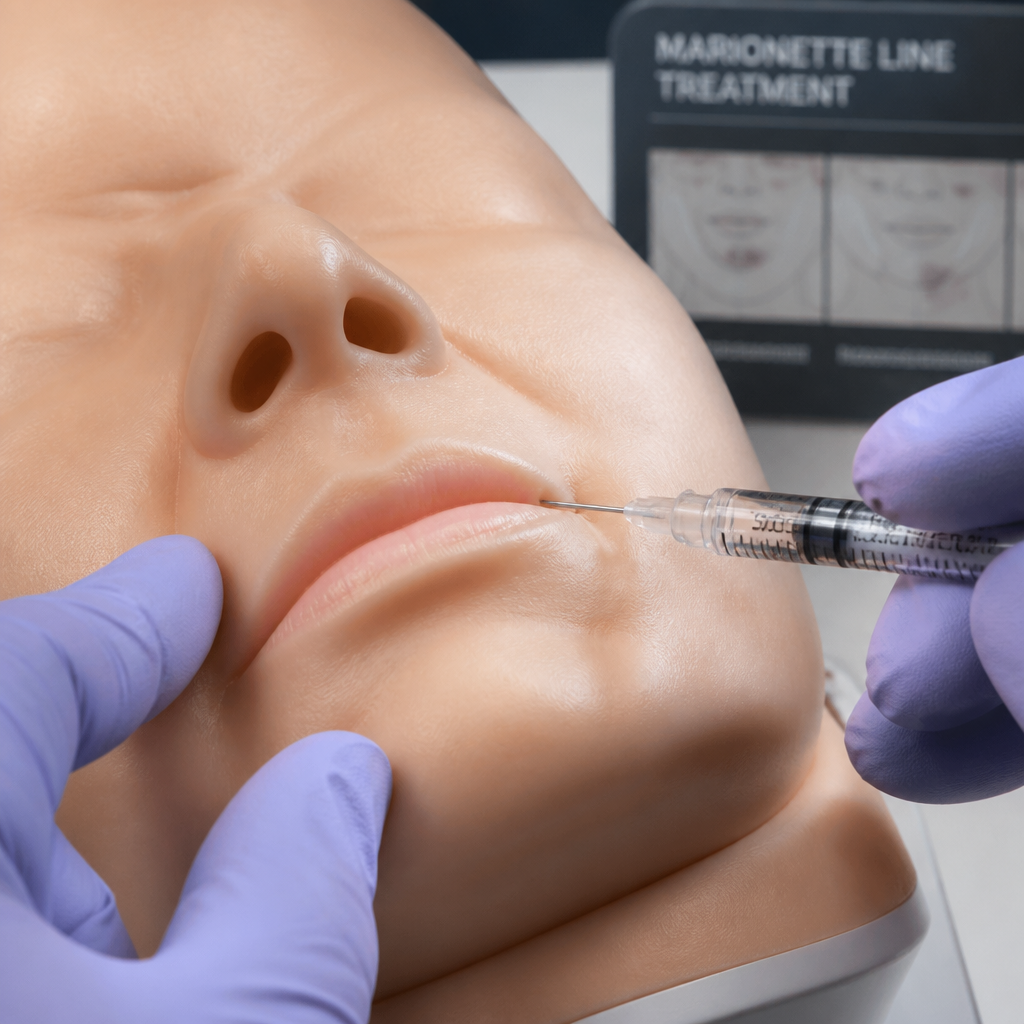
A common mistake among less experienced injectors is to treat the marionette line exactly as it presents: as a crease to be filled. Placing filler directly into the fold can create a pillow-like puffiness at the chin, flatten the natural transition between the lower face and the jaw, and make the correction obvious rather than invisible. The line may appear softer, but the overall result can look odd and unnatural.
The Correct Structural Approach
Experienced injectors approach marionette lines by treating the anatomy that creates the fold, not just the fold itself. This typically means placing product in the lateral cheek to re-support descended tissue, addressing the pre-jowl sulcus to restore jawline definition, and then using a smaller amount of product in or immediately adjacent to the marionette crease. The result is a natural-looking improvement in the entire lower face, not just a filled line.
This is why the same amount of filler produces dramatically different results depending on who places it and where. At Skin Excellence Medispa in Aurora, every lower face filler consultation includes a full facial assessment precisely because isolated treatment of the marionette area without considering the rest of the lower face consistently produces inferior results.
Managing Risks in the Lower Face
Vascular complications from filler, while rare, are most dangerous when product is placed without detailed anatomical knowledge. The facial artery and its branches run through the lower face in paths that vary between patients. Injection technique, depth, and aspiration protocols all matter in this region. Choosing a medically supervised clinic with trained, experienced injectors is not optional for this treatment area.
Combining Fillers with Other Treatments
For many patients, filler alone addresses the volume component of marionette lines effectively. For others, particularly those with moderate skin laxity or reduced skin quality, combining fillers with complementary treatments produces significantly better results than filler alone.
At Skin Excellence Medispa, the most common combination approaches for lower face rejuvenation include pairing dermal fillers with PRP or PRF therapy to improve skin quality and stimulate collagen from the inside, and combining fillers with micro-needling to address skin texture and tightness that filler cannot touch. These combinations work because they address different layers of the problem simultaneously: volume is restored by the filler, and skin quality and firmness are addressed by the regenerative treatment.
For patients with early marionette lines and good skin quality who want to prevent deeper development, Sculptra used proactively can be a smart long-game option. It builds collagen gradually, so the improvement is subtle and progressive rather than sudden, and the results extend well beyond what HA fillers typically offer in this area.
Neuromodulators such as Botox or Xeomin are also sometimes used in combination. Relaxing the depressor anguli oris muscle, which pulls the corners of the mouth downward, complements filler by reducing the mechanical force that deepens the marionette fold over time. This is not a standard add-on for every patient, but for patients whose muscle activity is a significant contributing factor, it adds meaningful value to the overall plan.
The right combination depends entirely on your anatomy and your goals. What works well for one patient may be unnecessary for another. This is why the consultation is not a formality at Skin Excellence Medispa; it is the foundation of every effective treatment plan.
If you are in the Aurora, Richmond Hill, Newmarket, or broader GTA area and considering lower face filler treatment, book a consultation at Skin Excellence Medispa to have your specific concerns assessed by an experienced injector.
Frequently Asked Questions
How much filler is needed to treat marionette lines?
The amount varies considerably based on the depth of the lines, the degree of volume loss in the surrounding lower face, and whether adjacent areas like the jawline or cheeks are also being addressed. Most patients need somewhere between one and four syringes total for a comprehensive lower face treatment. An injector who quotes a flat number before seeing you in person is giving you a guess, not an assessment.
Is filler for marionette lines painful?
Most patients describe the experience as mild to moderate discomfort rather than significant pain. Most fillers used in this area contain lidocaine, a local anesthetic mixed into the product, which reduces discomfort as the treatment progresses. Topical numbing cream applied beforehand further reduces sensitivity. The lower face is generally more comfortable to inject than the lips, which many patients find reassuring.
How long do results last for mouth corner fillers in Aurora?
Hyaluronic acid fillers in the lower face typically last between 6 and 12 months, though individual variation is significant. Patients with faster metabolism, very active facial movement, and higher-intensity exercise habits tend to metabolize filler more quickly. Collagen-stimulating options like Sculptra can produce results that last considerably longer, though results build gradually and are not immediately visible.
Can marionette line filler look unnatural?
Yes, and this is one of the more common concerns patients raise. An unnatural result is almost always a technique problem rather than a product problem. Overfilling the fold directly, placing product too superficially, or failing to address the surrounding structural anatomy can create visible puffiness, flattening of natural contours, or an obvious look. Choosing a skilled, experienced injector in a medically supervised setting significantly reduces this risk. If you are not happy with a hyaluronic acid filler result, the product can be dissolved with hyaluronidase.
At what age do marionette lines typically appear?
Early marionette lines can appear in the late thirties, particularly in patients with lean facial structure, significant sun exposure, or genetic predisposition. For most people they become more noticeable through the forties and become a prominent concern in the fifties and sixties as volume loss and tissue descent accelerate. There is no universal timeline, and lifestyle factors have a significant influence on how early and how deeply they develop.
Do I need to repeat filler treatments for marionette lines?
Yes. Hyaluronic acid fillers are temporary by design and will be metabolized over time. Maintenance treatments are needed to preserve the result, typically once a year or sometimes more frequently depending on individual metabolism and product choice. Consistent maintenance tends to be more efficient than allowing the filler to fully dissipate and starting over, because the scaffolding effect from previous treatment helps new product integrate better.
Are lower face fillers in the GTA safe?
Dermal fillers are Health Canada-regulated products and, when administered by trained, medically supervised injectors, have a well-established safety profile. Risks include bruising, swelling, asymmetry, and in rare cases more serious vascular complications. The risk of complications is meaningfully higher when treatments are performed by undertrained providers outside of a medically supervised setting. Selecting a reputable medical aesthetic clinic with experienced practitioners is the most important safety step you can take.
Have you had filler treatment for marionette lines, or are you weighing your options for lower face rejuvenation in the Aurora and GTA area? Share your questions or experience in the comments below.
References
- Clinical overview of dermal fillers for marionette lines: techniques, product options, and expected results
- Comprehensive guide to filler for jowls and marionette lines: candidacy, limitations, and approach
- Cleveland Clinic patient education resource on marionette lines: causes, risk factors, and treatment options
- Treatment overview for marionette lines including filler product selection and structural injection approach
- Comparison of dermal filler types for marionette lines including hyaluronic acid, Sculptra, and Radiesse