Walk into a standard laser clinic in the Greater Toronto Area and ask about laser hair removal for darker skin, and too often you will hear some version of “we can treat you, but results may vary.” That non-answer has left a lot of GTA residents with South Asian, Black, Middle Eastern, or mixed heritage sitting on the sidelines of a treatment that absolutely can work for them. The real issue is not skin tone. It is technology choice and practitioner knowledge. Laser hair removal skin tones GTA is not a niche concern: the GTA is one of the most ethnically diverse regions in the world, and clinics that cannot confidently treat the full Fitzpatrick spectrum are simply not equipped for this market. Here is what you actually need to know before booking.
Table of Contents
- Quick Takeaways
- The Fitzpatrick Scale: Why It Drives Every Laser Decision
- Which Laser Technology Works for Which Skin Tone
- The Real Risks for Fitzpatrick IV-VI Skin
- How Many Sessions and What Results to Expect
- Pre-Treatment and Aftercare That Actually Matters
- What to Look for When Choosing a Clinic in Aurora or the GTA
- Laser Technology Comparison by Skin Tone
- Frequently Asked Questions
- References
Quick Takeaways
| Key Insight | Explanation |
|---|---|
| Nd:YAG 1064 nm is the gold standard for dark skin | Its longer wavelength bypasses surface melanin and targets the follicle more selectively, making it the safest option for Fitzpatrick types V and VI. |
| IPL is not a laser and carries real risk on deeper skin tones | Intense Pulsed Light cannot distinguish between skin pigment and hair pigment the way a targeted laser can. Fitzpatrick IV+ skin should avoid IPL for hair removal. |
| Skin type IV is often treated safely with diode, but settings matter enormously | Diode lasers at 810 nm can work for intermediate phototypes when run with appropriate fluence, pulse duration, and contact cooling. A one-size setting is a warning sign. |
| Tanning before a session can change your effective skin type overnight | A summer tan raises your melanin level significantly, increasing burn and hyperpigmentation risk even if you were fine at your last appointment. |
| Most people need 6 to 8 sessions, not 3 | Hair grows in cycles. Any clinic promising full results in 3 sessions is overselling. Coarse, dark hair on lighter skin tends to respond fastest; finer hair or hormonally driven growth may need more. |
| Post-inflammatory hyperpigmentation (PIH) is the most common complication in darker skin | PIH is usually preventable with the right laser, correct settings, and diligent sun protection before and after every session. |
| A thorough consultation is not optional | Experienced practitioners assess your Fitzpatrick type, hair colour, medical history, and recent sun exposure before touching any device to your skin. Skip any clinic that skips this step. |
The Fitzpatrick Scale: Why It Drives Every Laser Decision
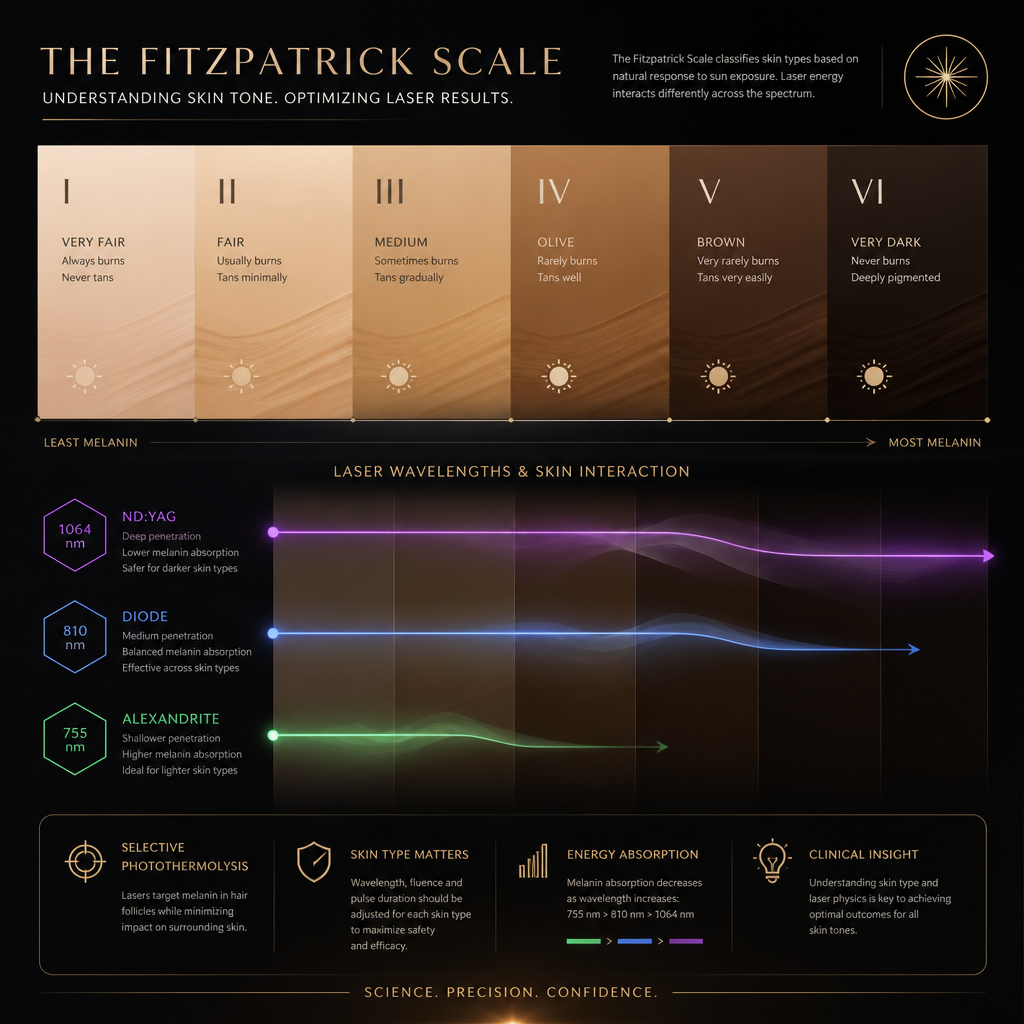
The Fitzpatrick scale is the standard classification system used to categorize human skin by its melanin content and its response to ultraviolet exposure. It runs from Type I (very fair, always burns, never tans) to Type VI (deeply pigmented, never burns). Every responsible laser practitioner uses it to select the correct device, wavelength, fluence, and pulse duration before treating you.
Types I through III have lower concentrations of melanin in the epidermis. Traditional laser systems were historically designed around these skin tones, which is why the industry’s early reputation for being “not suitable for darker skin” existed. That reputation is now outdated, but only in clinics that have invested in the right technology.
Types IV through VI carry higher epidermal melanin. This matters because laser energy is attracted to melanin. When a device cannot distinguish between the melanin in the hair follicle and the melanin in the surrounding skin, it damages both. The clinical result is burns, blistering, or persistent darkening of the treated area, a condition called post-inflammatory hyperpigmentation. None of this is inevitable. It is the result of using the wrong tool.
In the GTA, a large proportion of residents fall into Fitzpatrick types III through VI. This is not a minority concern. If a clinic cannot confidently discuss the Fitzpatrick scale and explain which technology they are using for your specific type, that is meaningful information about their level of expertise.
Which Laser Technology Works for Which Skin Tone
Not all lasers are created equal, and the wavelength determines almost everything when it comes to safety and efficacy across skin tones. There are three main technologies used for hair removal, and they are not interchangeable.
Nd:YAG 1064 nm: The Safest Choice for Dark Skin
The long-pulsed Nd:YAG laser operating at 1064 nanometres is the most validated technology for Fitzpatrick types V and VI. Its longer wavelength penetrates deeper into the dermis and is absorbed far less by epidermal melanin, which dramatically reduces the risk of surface burns and pigment changes. Clinical research published in peer-reviewed literature has confirmed that the long-pulsed 1064 nm Nd:YAG produces significantly better hair reduction results in darker skin compared to IPL, with one study reporting roughly 79% hair reduction on the laser side versus 54% on the IPL side at six months.
For GTA clients of South Asian, East African, West African, Caribbean, or Middle Eastern descent with deeper skin tones, Nd:YAG should be the starting question in any consultation. If a clinic does not have it, ask why.
Diode 810 nm: Effective for Mid-Range Skin Tones with Proper Settings
Diode lasers operating around 808 to 810 nm occupy the middle ground. They can treat Fitzpatrick types I through IV safely when the device includes robust contact cooling and the practitioner runs the appropriate settings for that phototype. A well-configured diode on a Type IV client is reasonable practice. The same diode on a Type V or VI client at standard settings is not.
The key variable is not just the wavelength but the combination of fluence, pulse duration, and skin cooling. This is why practitioner training matters as much as the device on the shelf.
IPL: Not a Laser, and Not Appropriate for Darker Skin
Intense Pulsed Light is often marketed alongside laser treatments, but it is a fundamentally different technology. IPL emits a broad spectrum of light rather than a single targeted wavelength. Because it cannot selectively target the hair follicle while sparing epidermal melanin, it carries a meaningfully higher risk of burns, hyperpigmentation, and inconsistent results on Fitzpatrick types IV and above. For lighter skin tones with dark hair, IPL can deliver results. For anyone with a moderate to deep skin tone, it is simply not the right tool for hair removal.
Pro tip: Before your first session, ask your provider specifically which device they will use, what wavelength it operates at, and what their experience is treating clients at your Fitzpatrick type. A confident, specific answer tells you a great deal. Vague reassurances do not.
The Real Risks for Fitzpatrick IV-VI Skin
Understanding what can go wrong is not meant to discourage treatment. It is meant to help you evaluate whether the clinic in front of you knows what they are doing. The risks are real but almost entirely preventable with appropriate technology and skill.
Post-Inflammatory Hyperpigmentation
PIH occurs when the skin produces excess melanin in response to inflammation or injury. Because Fitzpatrick IV-VI skin is more prone to PIH after any injury or external trigger, using a device that generates excessive heat in the epidermis creates exactly the conditions for it to develop. The result is dark patches that can last weeks to months. It is the most common complication when incorrect lasers are used on deeper skin tones, and it is largely avoidable.
Burns and Blistering
Burns are a direct consequence of the laser targeting epidermal melanin rather than the follicle. They indicate a mismatch between the device, the settings, and the client’s skin type. Proper contact cooling systems, correct pulse durations, and conservative fluence settings on the first session are the standard of care for darker skin tones.
Hypopigmentation
Less common but possible, hypopigmentation is the loss of pigment in the treated area, leaving lighter patches. It typically results from aggressive settings or repeated treatment of the same area without adequate recovery time.
Pro tip: A patch test on a small, less visible area before your full first session is a reasonable precaution for any Fitzpatrick type IV or higher. A reputable clinic will offer this; some will recommend it proactively.

How Many Sessions and What Results to Expect
The number of sessions required varies based on your hair colour, hair coarseness, the treatment area, hormonal factors, and your skin-to-hair contrast. Most people require between six and eight sessions spaced four to six weeks apart for the face and four to eight weeks apart for the body. This is not a shortcut industry. Anyone quoting three sessions as sufficient is almost certainly understating what is involved.
Laser hair removal works by targeting hair in its active growth phase (anagen). Because only a portion of hairs are in anagen at any given time, multiple sessions are required to catch each follicle at the right moment. This is true for every skin tone.
What Affects Your Personal Session Count
Coarse, dark hair on lighter skin tends to respond fastest because the contrast between hair pigment and skin pigment is highest. For darker skin tones where the contrast is lower and where the Nd:YAG’s more conservative energy delivery is necessary, results are still excellent but may require the higher end of the six-to-eight session range, or occasionally more, particularly in hormonally sensitive areas like the chin and jawline.
Hair that is fine, light (blonde, grey, or red), or driven by underlying hormonal conditions such as PCOS responds more slowly regardless of skin tone. If this applies to you, set realistic expectations from the start and discuss it with your practitioner rather than discovering it after session four.
Maintenance After Your Initial Course
Laser hair removal produces long-term significant reduction, not necessarily permanent complete elimination. Most clients find they need an occasional maintenance session once or twice a year after completing their initial course. Hormonal changes (pregnancy, menopause, medication changes) can stimulate dormant follicles. This is normal, manageable, and far less time-consuming than the initial treatment phase.
Pre-Treatment and Aftercare That Actually Matters
The work you do between sessions has a direct impact on your results and your safety. This is especially true for clients with Fitzpatrick types III through VI, where sun exposure is the single biggest controllable risk factor.
Before Every Session
Avoid sun exposure and tanning beds for at least four weeks before treatment. Sun exposure raises your skin’s melanin content, which effectively raises your Fitzpatrick type for treatment purposes. A client who is a stable Type IV but arrives with a summer tan may temporarily function as a Type V, changing the risk profile significantly. If excessive sun exposure occurred before your appointment, a responsible practitioner will postpone your session until your natural skin tone returns.
Do not wax, pluck, or use depilatory creams in the weeks before your session. These methods remove the hair shaft from the follicle, which is what the laser needs to target. Shaving is the appropriate method in the days before treatment, as it leaves the follicle intact.
Avoid active skincare ingredients (retinoids, AHAs, BHAs) on the treatment area for several days before your appointment, as they can sensitize the skin.
After Every Session
Daily broad-spectrum sunscreen (SPF 30 minimum, SPF 50 preferred) on treated areas is non-negotiable. Even in Ontario’s winters, UV exposure on recently treated skin can trigger PIH. The treated area is more photosensitive for several weeks after each session.
Avoid heat: saunas, hot showers, and intense exercise for 24 to 48 hours after treatment. The skin is actively processing the thermal effect of the laser during this window, and adding more heat stress can increase redness and irritation.
Mild redness and a sensation similar to mild sunburn immediately after treatment is normal. If you experience significant blistering, persistent pigment changes, or prolonged discomfort, contact your clinic promptly.
What to Look for When Choosing a Clinic in Aurora or the GTA
The GTA has no shortage of laser clinics. The difference between a mediocre experience and a genuinely effective, safe one comes down to a few specific things that are worth investigating before you commit.
Technology on the Floor, Not Just on the Website
Ask which specific devices the clinic uses and which one they plan to use for your skin type. A clinic that has only one laser system and applies it to everyone regardless of Fitzpatrick type is cutting corners. Safe laser hair removal in Aurora and the broader GTA requires access to technology that can be matched to the client, particularly for types IV through VI.
Practitioner Training and Experience with Skin of Colour
Ask directly how many clients with your skin tone the practitioner has treated and what their complication rate looks like. A confident, experienced practitioner will welcome the question. Someone who pivots to generic reassurances has told you something important.
The Consultation Is the First Test
A proper initial consultation should include a Fitzpatrick assessment, a review of your medical history (including any medications that increase photosensitivity), a discussion of your hair colour and coarseness, and a conversation about realistic timelines and results. If the consultation is shorter than ten minutes, or if no one asked about your medications or sun habits, consider that a concern.
At Skin Excellence Medispa in Aurora, consultations are built around your individual skin profile. The goal is not to move you through a protocol but to build a treatment plan that accounts for your specific Fitzpatrick type, lifestyle, and aesthetic goals. For GTA residents looking for safe laser hair removal in Aurora with practitioners experienced across all skin tones, the clinic’s approach to personalized care is what distinguishes the experience.
The right laser at the wrong settings is as problematic as the wrong laser at the right settings. Skill, technology, and client assessment must work together. One without the others is not safe care.
Laser Technology Comparison by Skin Tone
| Technology | Best Suited For (Fitzpatrick Types) | Key Considerations for GTA Clients |
|---|---|---|
| Nd:YAG 1064 nm | Types IV, V, VI (and tanned skin of any type) | Gold standard for darker skin tones. Longer wavelength minimizes epidermal melanin absorption. Clinically demonstrated superior efficacy over IPL in darker skin. Slight higher discomfort than diode is common but manageable with cooling. |
| Diode 810 nm | Types I, II, III, and select Type IV | Effective for lighter to medium skin tones with high hair-to-skin contrast. Can be used on Type IV with appropriate device settings and contact cooling. Not appropriate for Types V-VI. Comfortable treatment experience with modern cooling technology. |
| IPL (Intense Pulsed Light) | Types I, II, III only | Broad-spectrum light, not a true laser. Not suitable for darker skin tones due to inability to selectively target follicle melanin over epidermal melanin. Risk of burns and hyperpigmentation is meaningful for Types IV and above. Not recommended for laser for dark skin Ontario clients. |
Frequently Asked Questions
Is laser hair removal safe for Black and South Asian skin tones?
Yes, when the correct technology is used. Fitzpatrick types V and VI require a long-pulsed Nd:YAG 1064 nm laser operated by a practitioner with experience treating deeper skin tones. With the right device and proper settings, laser hair removal is both safe and effective for Black and South Asian clients. The risk comes from using inappropriate technology, not from the client’s skin type itself.
Why do some clinics say they cannot treat dark skin?
Most often, it means that clinic does not own the right equipment. Clinics that rely solely on diode or IPL systems are accurately identifying their own limitations. This is not a universal truth about laser hair removal. It is a statement about that specific clinic’s technology. If you have heard this, seek a clinic that has invested in Nd:YAG technology and has demonstrated experience with Fitzpatrick types IV through VI.
I have darker skin but light-coloured hair. Will laser work for me?
This is one of the more genuinely challenging combinations in laser hair removal. Laser targets the melanin in the hair follicle, so fine, light, blonde, grey, or red hair responds poorly regardless of skin tone. For dark skin with light hair, results will be limited. Your practitioner should tell you this clearly during consultation rather than taking your money for a course unlikely to deliver significant reduction. Discuss realistic expectations upfront.
How long before a session should I avoid the sun?
A minimum of four weeks of sun avoidance before treatment is the general guidance. Tanning, whether from outdoor sun or tanning beds, raises your skin’s melanin level and can shift your effective Fitzpatrick type upward, increasing the risk of burns and hyperpigmentation during treatment. If you arrive at a session with visible tanning, your practitioner should postpone the treatment until your natural skin tone fully returns.
Does laser hair removal hurt more on darker skin?
The 1064 nm Nd:YAG, the appropriate laser for darker skin, is sometimes described as delivering a slightly stronger sensation than diode, which is commonly compared to a rubber band snap. This varies significantly by treatment area, individual pain tolerance, and the cooling technology the device uses. Most clients find it very manageable, particularly with modern devices that include contact or dynamic cooling. Numbing cream can be applied to sensitive areas if needed. Discomfort is temporary and reduces as the hair becomes finer over successive sessions.
Can I get laser hair removal if I have a condition like PCOS that causes excess hair growth?
Yes, laser hair removal can be highly effective for clients with PCOS-related hair growth, but managing expectations is important. Hormonal conditions that actively stimulate hair follicles can cause regrowth of hair that was successfully treated, particularly in androgen-sensitive areas like the chin, jawline, and abdomen. Many clients with PCOS achieve excellent ongoing reduction, but may need more sessions initially and periodic maintenance treatments. It is worth discussing your medical history fully with your practitioner before beginning a course of treatment.
Does Skin Excellence Medispa treat all Fitzpatrick skin types?
Yes. At Skin Excellence Medispa in Aurora, Ontario, the team assesses every client’s Fitzpatrick type as part of the initial consultation and tailors the treatment approach accordingly. The clinic serves clients from across the Greater Toronto Area and is experienced in treating the full range of skin tones safely. You can learn more about their laser hair removal services or contact the clinic to book a consultation.
If you have questions about your skin tone and laser hair removal or want to share your experience as a GTA client navigating this process, leave a comment below and help others in the community make a more informed decision.
We would love your feedback and any insights you would share with others. What perspective would you add?
References
- PubMed clinical study comparing Nd:YAG laser and IPL for hair removal in darker skin tones
- NIH: Long-pulsed 1064 nm Nd:YAG laser hair removal efficacy and safety in Indian skin phototypes
- Candela Medical: Clinical differences in Fitzpatrick skin types and laser treatment considerations
- Sun exposure guidelines before and after laser hair removal treatments
- How many laser hair removal treatments are needed based on skin type and hair colour