

Most people notice it gradually. The skin that once snapped back after a long week starts to look a little more settled, a little less firm. Lines appear where there used to be none. This is not a willpower problem or a skincare-routine failure. It is collagen loss, and it starts earlier than most people expect. For adults across the Greater Toronto Area dealing with collagen loss skin aging in Aurora and surrounding communities, understanding exactly what is happening beneath the surface, and which treatments can reverse it, makes the difference between chasing results and actually achieving them.
Table of Contents
- Quick Takeaways
- What Collagen Does and Why You Lose It
- How Collagen Loss Actually Shows Up on Your Face
- Collagen-Stimulating Treatments in the GTA: What Works and How
- Treatment Comparison: Choosing the Right Approach
- What to Expect From a Collagen-Focused Treatment Plan
- Frequently Asked Questions
- References
Quick Takeaways
| Key Insight | Explanation |
|---|---|
| Collagen loss begins in your mid-twenties | Research shows collagen density decreases by roughly 1% per year throughout adult life, starting well before visible aging appears. |
| Menopause dramatically accelerates the rate | Women can lose up to 30% of skin collagen in the first five years after menopause, making this a critical intervention window. |
| Topical creams cannot replace lost structural collagen | Collagen molecules are too large to penetrate the dermis through topical application. Treatments must work at the dermal level to produce real results. |
| Sculptra stimulates your own collagen production over months | Made from poly-L-lactic acid, Sculptra works in the deeper dermis to gradually rebuild collagen, with results that can last beyond two years. |
| Micro-needling triggers a wound-healing collagen cascade | Controlled micro-injuries prompt the skin to produce new collagen and elastin as part of the natural healing process, improving texture and firmness. |
| PRP and PRF supercharge collagen-induction treatments | Combining platelet-rich plasma or fibrin with micro-needling delivers concentrated growth factors directly to the dermis, accelerating repair. |
| UV exposure is the largest external driver of collagen breakdown | Beyond age, UV radiation is the dominant environmental cause of collagen degradation, making sun protection a non-negotiable part of any treatment plan. |
What Collagen Does and Why You Lose It
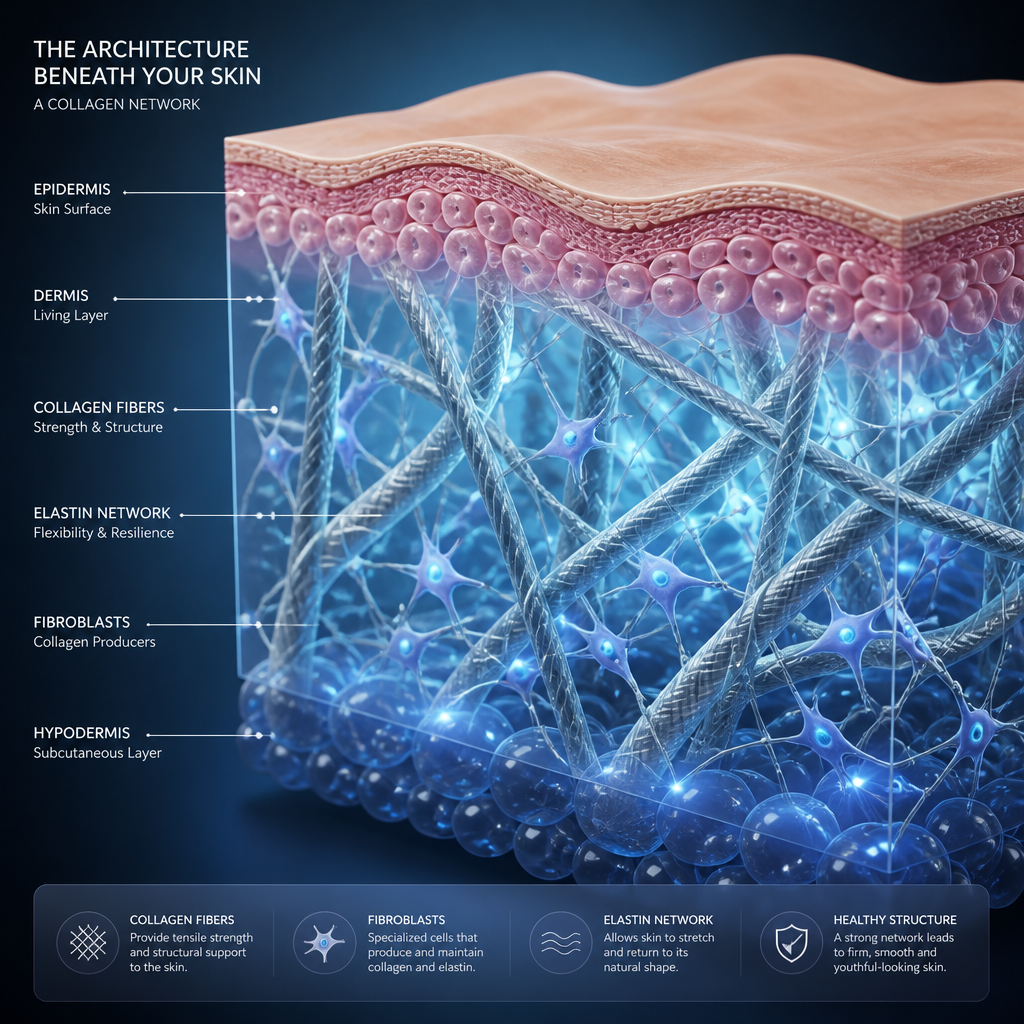
Collagen is the main structural protein in connective tissue, including the dermis of your skin. It is what gives skin its density, bounce, and resistance to gravity. When collagen fibrils are dense and well-organized, skin looks plump and firm. When they fragment and thin out, skin becomes lax, creased, and dull.
The decline is not dramatic at first. Research published in peer-reviewed literature confirms that skin collagen decreases by approximately 1% per year throughout adult life, with the rate consistent across genders. That is a slow bleed in your twenties and thirties, then a sharper drop for women entering perimenopause and menopause. Studies indicate that women can lose up to 30% of skin collagen in the first five years after menopause, driven by the sudden drop in estrogen, which plays a direct role in collagen synthesis.
Two mechanisms drive the loss. First, the skin produces less new collagen over time as fibroblast activity slows. Second, collagenase enzymes, particularly matrix metalloproteinases (MMPs), become more active with age and UV exposure, breaking down existing collagen faster than it can be replaced. The result is a structural deficit that no amount of hyaluronic acid serum can fully address on its own.
External factors accelerate the process significantly. UV radiation is the single largest environmental driver of collagen breakdown. Smoking, chronic sugar consumption (which causes glycation of collagen fibers), poor sleep, and repetitive muscle movement all contribute. Genetics play a smaller role than most people assume; research suggests that hereditary factors account for only a small fraction of skin aging, with external and lifestyle factors driving the majority.

How Collagen Loss Actually Shows Up on Your Face
Collagen loss does not announce itself with a single dramatic change. It accumulates as a collection of shifts that individually seem minor but together change the overall character of the face. Knowing what to look for helps clients identify the right treatment targets.
Fine Lines Versus Deep Folds
Fine lines around the eyes and mouth are among the earliest signs, appearing where the skin is thinnest and most mobile. As collagen density continues to drop, these transition into deeper folds, particularly the nasolabial lines and marionette lines that run from the nose and corners of the mouth downward. These deeper lines represent genuine structural changes in the dermis, not just surface dehydration.
Loss of Volume and Facial Contour
The face does not just wrinkle with age. It deflates. The cheeks flatten, the temples hollow, and the jawline softens. This volumetric loss is partly fat redistribution, but a significant portion is the collapse of the collagen scaffold that once held facial structures in a lifted position. Many people in their forties are surprised to realize that their main concern is not wrinkles at all, but this overall flattening of their features.
Skin Texture and Tone Changes
Collagen fragmentation in the aged dermis changes how light reflects off the skin. Healthy, dense collagen creates an even, slightly luminous surface. Thinned, disorganized collagen produces a duller, more uneven texture that makes pigmentation and pores look more prominent. No brightening serum can fully correct this because the issue is structural, not superficial.
The visible signs of aging skin are almost always downstream effects of what is happening in the dermis. Treating only the surface while the structural scaffold continues to deteriorate is like painting a wall without fixing the cracks behind it.
Collagen-Stimulating Treatments in the GTA: What Works and How
The good news is that modern medical aesthetics has moved well past surface-level interventions. The most effective collagen-stimulating treatments in the GTA work at the dermal level, either triggering the skin’s own repair mechanisms or providing a physical scaffold for new collagen to grow around. At Skin Excellence Medispa in Aurora, several of these treatments are available as standalone protocols or combined approaches, depending on what each client’s skin actually needs.
Sculptra: Rebuilding the Collagen Scaffold Over Time
Sculptra is made from poly-L-lactic acid (PLLA), a biocompatible synthetic material that is injected into the deeper layers of the dermis. Unlike hyaluronic acid fillers that add immediate volume, Sculptra works gradually over several weeks to months. The PLLA microparticles stimulate fibroblasts to produce new collagen, creating a slow, natural-looking restoration of volume and firmness. Results can last well beyond two years with a proper treatment series, making it one of the most durable anti-aging medspa options in Aurora, Ontario for clients dealing with significant volumetric loss.
In practice, Sculptra is best suited for clients who want structural improvement rather than a quick fix. It requires patience, typically involving a series of sessions spaced weeks apart, and the results build progressively rather than appearing immediately after the first appointment.
Pro tip: Sculptra results are not visible immediately after treatment. Clients who expect an instant transformation are often disappointed, while those who understand the gradual collagen-building process are among the most satisfied with their long-term outcomes. Set your expectations correctly from the first consultation.
Micro-Needling and PRP/PRF: The Collagen Induction Approach
Micro-needling works on a fundamentally different principle. By creating controlled micro-injuries in the skin with fine needles, it triggers the body’s natural wound-healing cascade, which includes a significant increase in collagen and elastin production. The skin responds to these micro-channels as a repair signal, flooding the area with growth factors and fibroblast activity.
When micro-needling is combined with PRP (platelet-rich plasma) or PRF (platelet-rich fibrin), the effect is amplified. These are derived from the client’s own blood, concentrated to deliver a high load of platelets and growth factors directly into the dermis via the micro-channels created by the needles. The combination accelerates tissue repair and collagen synthesis in a way that either treatment alone cannot match. Clients typically see improvements in skin texture, firmness, and fine lines after a series of sessions, with results continuing to develop for several weeks post-treatment.
Dermal Fillers: Immediate Support While Collagen Rebuilds
Hyaluronic acid dermal fillers do not stimulate collagen in the same direct way as Sculptra or micro-needling. What they do exceptionally well is restore immediate volume and support to areas where structural collapse has already occurred, particularly the cheeks, tear troughs, lips, and nasolabial folds. For many clients, fillers serve as a bridge treatment, addressing the most visible volume loss quickly while a collagen-stimulating protocol is put in place alongside them.
Botox: Indirect Protection for Collagen
Botox does not stimulate collagen, but it protects it. By relaxing the repetitive muscle movements that create dynamic wrinkles, Botox reduces the mechanical stress on dermal collagen in high-movement areas like the forehead, between the brows, and around the eyes. Consistent Botox use over years is genuinely protective, not just cosmetic, because it slows the breakdown of collagen caused by repeated folding and creasing of the skin in the same spots.
Treatment Comparison: Choosing the Right Approach
One of the most common mistakes clients make is choosing a treatment based on what they have heard about rather than what their skin actually needs. Below is a direct comparison of the three main collagen-focused approaches available at a medical aesthetic clinic.
| Treatment | How It Addresses Collagen Loss | Best Suited For |
|---|---|---|
| Sculptra (Poly-L-Lactic Acid) | Stimulates fibroblasts to produce new collagen from within the deep dermis. Results build over months and are long-lasting. | Clients with significant volume loss, hollowing temples or cheeks, and those who prefer gradual, natural-looking restoration over immediate change. |
| Micro-Needling with PRP/PRF | Triggers the body’s wound-healing response to produce collagen and elastin. PRP/PRF adds a concentrated dose of growth factors. | Clients focused on skin texture, fine lines, pore size, mild laxity, and overall skin quality. Also effective for those in their thirties beginning to see early collagen loss. |
| Hyaluronic Acid Dermal Fillers | Do not directly stimulate collagen production. Restore volume and support immediately, reducing the mechanical stress on remaining collagen fibers. | Clients needing immediate, visible correction of specific areas. Often used alongside collagen-stimulating treatments as part of a comprehensive plan. |
Pro tip: The most effective treatment plans for collagen loss rarely rely on a single modality. At a well-run medispa, your practitioner should be discussing how treatments work together, not just selling you the most popular option on its own. If a consultation does not involve a conversation about your skin’s specific collagen needs, ask for one.
What to Expect From a Collagen-Focused Treatment Plan
A realistic collagen-rebuilding plan is not a single appointment. It is a phased approach that begins with an honest assessment of where the collagen deficit is most visible and what the underlying causes are, including lifestyle, sun history, and hormonal changes.
The Consultation: Setting Honest Expectations
A thorough consultation at Skin Excellence Medispa involves assessing the depth and location of collagen loss, discussing the client’s timeline and tolerance for visible results, and identifying whether any lifestyle factors are actively accelerating collagen breakdown. Clients who continue heavy UV exposure without protection between treatments will see slower results, full stop. That conversation needs to happen at the start, not after a second or third session with disappointing progress.
Treatment Sequencing That Makes Sense
In practice, clients with moderate to significant collagen loss often benefit from starting with a collagen-stimulating injectable like Sculptra while running a parallel series of micro-needling or micro-needling with PRP/PRF sessions. Fillers can be introduced at any point where specific areas need immediate correction. Botox is typically maintained on its standard schedule alongside this. The key is that each treatment is chosen for a reason tied to that specific client’s skin, not a one-size-fits-all package.
Home Care Is Not Optional
Medical-grade retinoids, SPF 50+ broad-spectrum sunscreen applied daily, and peptide-based products that support fibroblast activity are the non-negotiable pillars of home care between treatments. Clients who invest in clinic treatments but neglect sun protection are essentially filling a bucket with a hole in it. The clinic results are real, but they will be shorter-lived without the home care foundation to protect and extend them.
Frequently Asked Questions
At what age does collagen loss become significant enough to treat?
Most people begin losing collagen at a measurable rate in their mid-twenties, but visible changes typically become apparent in the mid-thirties. By the time clients start noticing laxity, hollowing, or a change in skin texture, there is already a meaningful structural deficit. Starting collagen-stimulating treatments in your thirties is genuinely preventive. Starting in your forties or fifties is still highly effective, but the treatment plan will need to address more accumulated loss.
Can I just take collagen supplements instead of getting treatments?
Oral collagen supplements are digested and broken down into amino acids before they reach your skin. While a diet rich in amino acids supports skin health generally, supplements do not deliver intact collagen to the dermis. Treatments like micro-needling with PRP/PRF and Sculptra work directly at the dermal level, which is where structural collagen needs to be rebuilt. The two are not equivalent approaches.
How long do results from collagen-stimulating treatments last?
It depends on the treatment and how well the results are maintained. Sculptra results, following a full series of treatments, can last over two years. Micro-needling results are cumulative and improve with each session, with optimal outcomes typically requiring three to four sessions and then periodic maintenance. Dermal fillers generally last six to eighteen months depending on the product and the area treated. Consistent home care, especially sun protection, directly extends the longevity of all of these results.
Is one collagen treatment enough, or do I need a series?
A single session of any collagen-stimulating treatment produces a response, but it is rarely enough to produce the kind of visible, lasting improvement most clients are looking for. Collagen remodeling is a biological process that takes time. The standard recommendation for micro-needling is a series of three to four sessions. Sculptra typically requires two to three sessions spaced weeks apart. A single session can be a useful starting point, but committing to a full series gives you results worth the investment.
What lifestyle factors should I change to slow collagen loss between treatments?
Daily SPF 50+ sunscreen use is the single highest-impact lifestyle change you can make, because UV exposure is the dominant external driver of collagen degradation. Beyond that, quitting smoking, reducing refined sugar intake, getting consistent sleep, and using a medical-grade retinoid at night all meaningfully support your skin’s ability to maintain and build collagen between clinic visits. These are not suggestions. They are the conditions under which your treatment results will actually hold.
Does Botox help with collagen loss?
Botox does not directly stimulate collagen production, but it does protect existing collagen by reducing the repetitive muscle contractions that mechanically break down dermal collagen over time in high-movement areas. Many clients who use Botox consistently over years find that the skin in treated areas ages more slowly than untreated areas, which is a real clinical observation that reflects this protective mechanism. For comprehensive collagen management, Botox works best as one component of a broader treatment plan.
Have you noticed changes in your skin’s firmness or texture recently? We would love to hear what questions or concerns brought you here, and what treatments you are curious about trying.
References
- Peer-reviewed research on collagen density decline rates across adult life, published in the scientific literature
- Study on the physical properties of aged versus young dermal collagen fibrils using atomic force microscopy
- Comprehensive review of microneedling mechanisms, clinical applications, and collagen-stimulating effects
- Clinical overview of how estrogen decline during menopause accelerates collagen loss and skin changes
- Cleveland Clinic patient resource explaining Sculptra as a collagen-stimulating injectable treatment