
Written by Skin Excellence Medispa Editorial Team.
Clinic review by Zahra Erfan, Owner of Skin Excellence Medispa.
If you are researching filler migration in Aurora, the first question is usually whether what you are seeing is normal settling or a real problem. Filler migration, where product ends up in an area other than where it was injected, can change the shape of a face in ways that are easy to miss at first and harder to reverse later. This guide explains how to spot filler migration and overfilling, why it often shows up weeks or years after treatment, and what a correction usually involves for residents across the GTA.
Table of Contents
- Quick Takeaways
- What Filler Migration Actually Is
- Warning Signs of Migration and Overfilling
- Why Overfilling Shows Up Weeks or Years Later
- Correction Options Once Filler Has Moved
- Avoiding Overfilling at Your Next Appointment
- Frequently Asked Questions
- References
Quick Takeaways
| Key Insight | Explanation |
|---|---|
| Migration can appear long after treatment | A narrative review of 28 reported cases found filler migration can occur even several years after the original treatment. |
| Some injection sites are reported more often | Injections into the nose, lips, nasolabial folds and forehead appear in migration reports more often than cheek injections. |
| Overfilling can look like swelling | An overfilled undereye or cheek can mimic malar edema or nodules, so an in-person review should come before any top-up. |
| Bluish skin can signal superficial placement | The Tyndall effect, a bluish tint caused by light scattering, appears when hyaluronic acid sits too close to the surface. |
| The filler type decides the correction | Hyaluronic acid responds to hyaluronidase, while permanent fillers usually require surgical removal. |
| Keep your treatment records | The product name, injection sites and volumes make it far easier for another injector to plan a correction. |
What Filler Migration Actually Is
Filler is designed to integrate with tissue and soften over time, so some change in the first weeks is expected. Migration is a different problem, and it is the reason a result can look fine at the mirror and wrong in photos taken a few months later.
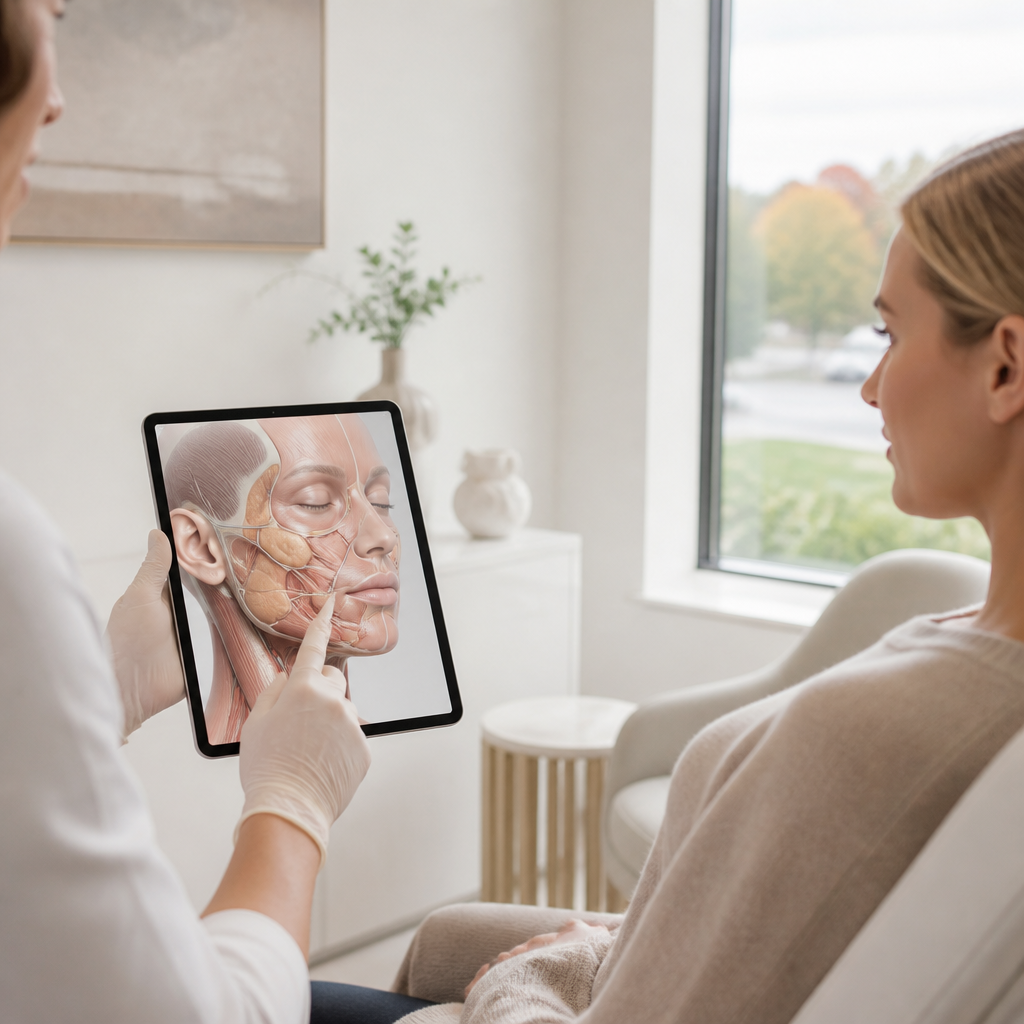
How migration differs from normal settling
A clinical review of undereye fillers defines filler migration as filler presence in an area other than the injection site. In other words, the product has traveled rather than simply settled into the tissue where it was placed.
In practice, four mechanisms come up again and again: filler volume that overflows the target area, injection under high pressure, repeated facial muscle movement, and gravity. Overflow and pressure are technique issues, which is why the injector’s plan matters as much as the product. Muscle movement and gravity explain why the same treatment can look different at three months than it did at two weeks.
Pro tip: Take front and side photos in the same lighting on the day of treatment and again every two weeks afterward. A written note of the product name, the areas treated and the volume used will make any future assessment far faster.
Where migration shows up most often
A narrative review of 28 reports found that affected patients ranged from 21 to 86 years old, with a mean age of 47. Women were reported 25 times more often than men, and hyaluronic acid and polyalkylimide were the most commonly encountered fillers. These figures describe what has been reported, not how many treatments are performed, so read them as patterns rather than odds.
Injections into the nose, lips, nasolabial folds and forehead, including the glabella, are reported more often than injections into the cheeks. Tear-trough correction carries a specific risk of orbital migration, which is one reason that area deserves a conservative plan and an experienced hand.
Warning Signs of Migration and Overfilling
Overfilling and migration often look the same to an untrained eye. The face is fuller, but in a way that feels off, and most people notice the change in photos before they notice it in the mirror.
Visual changes that suggest the filler has moved
Watch for puffiness that does not match your usual appearance, uneven fullness from one side to the other, soft lumps, or swelling in areas you did not intend to treat. Under the eyes, a bulging or puffy look can come from fluid collection and malar mounds as well as from filler, which is why the cause needs a professional look. If your face no longer looks like you, that alone is a reasonable reason to book a review.
Bluish discoloration deserves attention. The Tyndall effect appears when hyaluronic acid is placed too superficially, and it is not a cosmetic quirk that will simply fade on its own.
Symptoms that need a same-week appointment
Pain, warmth, redness, or a firm lump that appears weeks or months after treatment should not wait for your next scheduled visit. Foreign body granulomas, which form as an inflammatory response to injected material, are typically painful and have a delayed onset. Any change in how the eye or face moves after treatment also needs prompt assessment, because it can point to placement in the wrong plane.
Pro tip: If a change appears suddenly and worsens over a few days, contact your treating clinic the same day rather than waiting to see whether it settles.
Why Overfilling Shows Up Weeks or Years Later
Overfilling rarely announces itself on the day of the appointment. Swelling from the injection can hide the true result for days or weeks, and the final shape may take a while to become clear. A result that looks acceptable at a two-week check can still shift later.
Longer-lasting hyaluronic acid and the top-up trap
Hyaluronic acid fillers were traditionally regarded as lasting 3 to 12 months, but recent findings suggest some can last for years. That is useful information, but it creates a trap. If an injector assumes the product has gone, they may add more than the face needs, and the result can be a characteristic puffy look rather than natural volume.
In practice, a top-up should be based on a fresh assessment rather than a calendar reminder. Ask whether the area still has the volume you wanted before agreeing to add product.

Permanent fillers and very late reactions
Very late filler migration was seen more often with permanent fillers than with non-permanent products, and reports describe migration occurring years after the original treatment. The review also found that all filler types can be involved, so no product should be treated as risk-free.
Permanent products are the hardest to correct, which makes the product choice a decision to make carefully before the first syringe rather than after a problem appears.
Correction Options Once Filler Has Moved
A correction starts with one question: what kind of filler is in the face? For Aurora residents, filler migration is usually first noticed at home rather than in a clinic, so the product name from the original appointment is often the most useful piece of information you can bring to a review.
Dissolving hyaluronic acid filler with hyaluronidase
Hyaluronic acid fillers respond to hyaluronidase, an enzyme that breaks the product down. Dissolving filler with hyaluronidase is usually safe when handled by a qualified medical professional, but the same treatment done incorrectly can create problems of its own. It should never be attempted at home or by someone without medical training.
Pro tip: Hyaluronidase only works on hyaluronic acid. Before you book a correction, confirm the product name so the clinic knows whether enzyme treatment is even an option.
Surgical removal for permanent fillers
Migration of permanent fillers needs surgical treatment, according to the narrative review, because hyaluronidase has no effect on those products. Surgery is more invasive than an enzyme session and involves a longer recovery, so it is worth understanding before treatment rather than after a problem appears.
Why an in-person review comes first
A correction should begin with an in-person assessment. One aesthetic medicine article notes that an overfilled look may come from another complication, such as malar edema or nodule formation. Treating the wrong problem wastes time, adds more product and can make the picture harder to read.
Most overfilled faces can be addressed with safe and effective options, but the plan has to match the cause. The table below compares the most common approaches.
| Approach | Best suited for | Practical trade-off |
|---|---|---|
| Hyaluronidase dissolution | Hyaluronic acid fillers with overfilling or migration | Targets only hyaluronic acid, the response varies by person, and more than one session may be needed. |
| Surgical removal | Permanent fillers such as polyalkylimide | Needed when enzymes cannot help, but it is more invasive and requires a longer recovery. |
| In-person reassessment before any change | Unclear cases, including suspected malar edema or nodules | Adds a visit first, but prevents more filler from going into the wrong problem. |
Avoiding Overfilling at Your Next Appointment
Prevention is far easier than correction. The narrative review points to the same basics: detailed knowledge of facial anatomy, safer injection techniques, and an understanding of filler qualities. Each of these is something you can check before you sit in the treatment chair.
Questions to ask at your consultation
Ask which product will be used, why it suits the area, and how much volume is planned for each site. Ask how the injector approaches the areas where migration is reported more often, such as the nose, lips, nasolabial folds and under the eyes. A clinic that answers in specifics is showing you how it thinks.
Ask what happens if something looks wrong at a check-up. You want to know whether correction is available, who handles it and how quickly you can be seen.
Staged treatment and realistic goals
Staged treatment, meaning smaller volumes placed over more than one visit, lets the injector see how your face responds before adding more. It is slower, and some clients find that frustrating, but it reduces the chance of creating a result that later needs correction. Set a target with your injector before the first appointment, then judge progress against that target rather than against a photo you saw online.

Pro tip: If a provider suggests a large volume in a single session without explaining why, ask for a staged plan in writing before you agree.
Frequently Asked Questions
Can filler migrate years after treatment?
Yes. A narrative review of reported cases found migration can occur even several years after the original treatment, and very late migration was seen more often with permanent fillers.
How do I know whether I have filler migration or just swelling?
Swelling usually settles and follows a pattern tied to the treatment date. Lumps, persistent asymmetry, bluish discoloration, or changes that worsen over weeks need an in-person assessment, because only an examination can tell the two apart with confidence.
Does dissolving filler always fix overfilling?
No. Hyaluronidase only works on hyaluronic acid. Permanent fillers usually need surgical removal, and the result depends on the product, the amount involved and where it sits in the face.
Is it safe to have an overfilled face corrected in Aurora?
Correction should be done by a qualified medical professional after an in-person assessment. Ask whether the clinic can identify the product used, explain the correction plan and arrange follow-up if needed.
How soon should I see someone after noticing a change?
Pain, redness, warmth, a bluish tint, or any change in eye or facial movement should be assessed the same week. For milder changes, book a review promptly so the cause is identified before more filler is added.
About Zahra Erfan
Zahra Erfan is the owner of Skin Excellence Medispa in Aurora, Ontario. She oversees the clinic’s client experience, treatment standards, and aesthetic services. Her work with Skin Excellence gives her firsthand insight into the questions clients commonly ask when considering aesthetic treatments in Aurora.
Skin Excellence Medispa is an independently operated medical aesthetics clinic in Aurora, Ontario, owned by Zahra Erfan.
Skin Excellence Medispa
14845 Yonge Street, Unit 301
Aurora, Ontario L4G 6H8
(647) 979-5927
marketing@skinexcellencemedispa.com
Aurora, Ontario
This article is provided for general educational purposes and does not replace an individual medical consultation. Treatment suitability, risks and expected outcomes vary by patient and should be discussed with a qualified healthcare professional.
Considering a treatment in Aurora? Book a consultation with Skin Excellence Medispa to discuss your goals and determine whether it is appropriate for you.
What signs of overfilling have you or someone you know noticed, and how did the treating clinic handle it? Share your experience so others in the GTA can learn from it.
References
- Narrative review of filler migration after facial injections
- Clinical blog on undereye filler and filler migration
- Guide to correcting bad filler results
- Guide to fixing overfilled faces and dissolving excess filler
- Aesthetic medicine article on avoiding overfilled cheek results