
Someone in your network just raved about their results at a local medspa, and now you are curious. That word-of-mouth moment is the most common way GTA residents start their search for aesthetic treatments, and it is a good starting point. But a glowing referral is not a full vetting process. Aurora and the surrounding York Region have seen a growing number of medical spa clinics open their doors, and the quality, safety standards, and depth of clinical expertise vary considerably from one to the next. Finding the best medspa in Aurora means knowing which questions actually separate a genuinely clinical practice from a cosmetically branded one. The six questions below will do exactly that.
Table of Contents
- Quick Takeaways
- How Clinic Types Compare on These Standards
- Red Flags to Watch for Before You Book
After asking the six questions above, a few specific patterns should end your search for a particular clinic. Staff who cannot name the professional credentials of your treating practitioner, or who become defensive when you ask, have given you an answer even without using words.
Walk-in injection services with no consultation component remove the only clinical safety checkpoint between you and a potential complication. Rushed consultations that feel more like a menu presentation than a clinical assessment serve the clinic’s booking rate, not your safety. And pressure to commit to a treatment package during a first consultation, before you have had time to reflect, is a sales behavior, not a clinical one.
The clinics that are honest at the consultation, including about what they will not do or what is not right for you, are the ones worth trusting with your long-term care. That honesty is harder to fake than a glossy waiting room.
Pro tip: When a friend refers you to a clinic, ask them specifically what they liked about their practitioner’s approach, not just the result. Consistent answers about feeling heard, having questions answered thoroughly, and receiving honest recommendations are the clearest signal that a clinic operates with genuine clinical integrity.
Frequently Asked Questions
- References
Quick Takeaways
| Key Insight | Explanation |
|---|---|
| Ask who holds the needle, not just who owns the clinic | The practitioner performing your injectable or laser treatment must hold the appropriate professional license, whether a registered nurse, nurse practitioner, or physician. |
| Medical director presence matters in Ontario | Under CPSO rules, a medspa offering controlled acts must have a medical director who is genuinely involved in clinical oversight, not just listed on a website. |
| A real consultation is non-negotiable | Any clinic that offers to book you for injectables or laser without a prior consultation is skipping the only safety checkpoint between you and a potential adverse event. |
| Product brand transparency is a baseline trust signal | Reputable clinics name the exact brand of Botox, filler, or device they use. Vague answers or unusually low pricing can indicate unregulated or grey-market products. |
| Complication protocols reveal clinical maturity | Ask what happens after your appointment if you have a concern. A clinic with no clear answer has not thought through patient safety seriously enough. |
| Referral experience reflects clinic culture | When a friend refers you, their result is partly about the treatment and partly about the relationship they built with a practitioner who listened. Look for both. |
| Pressure to buy packages at consultation is a warning sign | A good medspa recommends only what you need after assessing your skin and goals. Aggressive upselling at the first appointment signals the wrong priorities. |
Who Actually Performs Your Treatment?
This is the single most important question you can ask, and it is the one most people forget to raise. Many clinics have a beautiful front desk, a polished website, and impressive before-and-after photos. None of that tells you whether the person injecting your Botox or operating the laser on your face holds a current, appropriate professional license in Ontario.
In Ontario, injecting Botox and dermal fillers qualifies as a controlled act under provincial healthcare law. Performing a controlled act requires either a physician, a nurse practitioner with independent prescribing authority, or a registered nurse working under a direct order or medical directive from a supervising physician or NP. An aesthetician, regardless of how experienced, cannot legally perform these injections.
When you call or book a consultation, ask directly: “What is the professional designation of the person who will perform my treatment?” The answer should be specific. If staff hesitate or give you a vague title, that hesitation is itself informative.
What credentials look like in practice
At a properly structured clinic, you will hear answers like “registered nurse under medical directive” or “nurse practitioner.” You should also be able to look up that professional’s registration number through the College of Nurses of Ontario’s public register. This takes two minutes and confirms the license is current and in good standing.
Pro tip: Do not confuse certification courses with professional licensing. A weekend aesthetics course is not the same as a nursing or medical degree. Ask specifically about the regulated professional designation, not the training certificate displayed on the wall.

Is There Real Medical Oversight on Site?
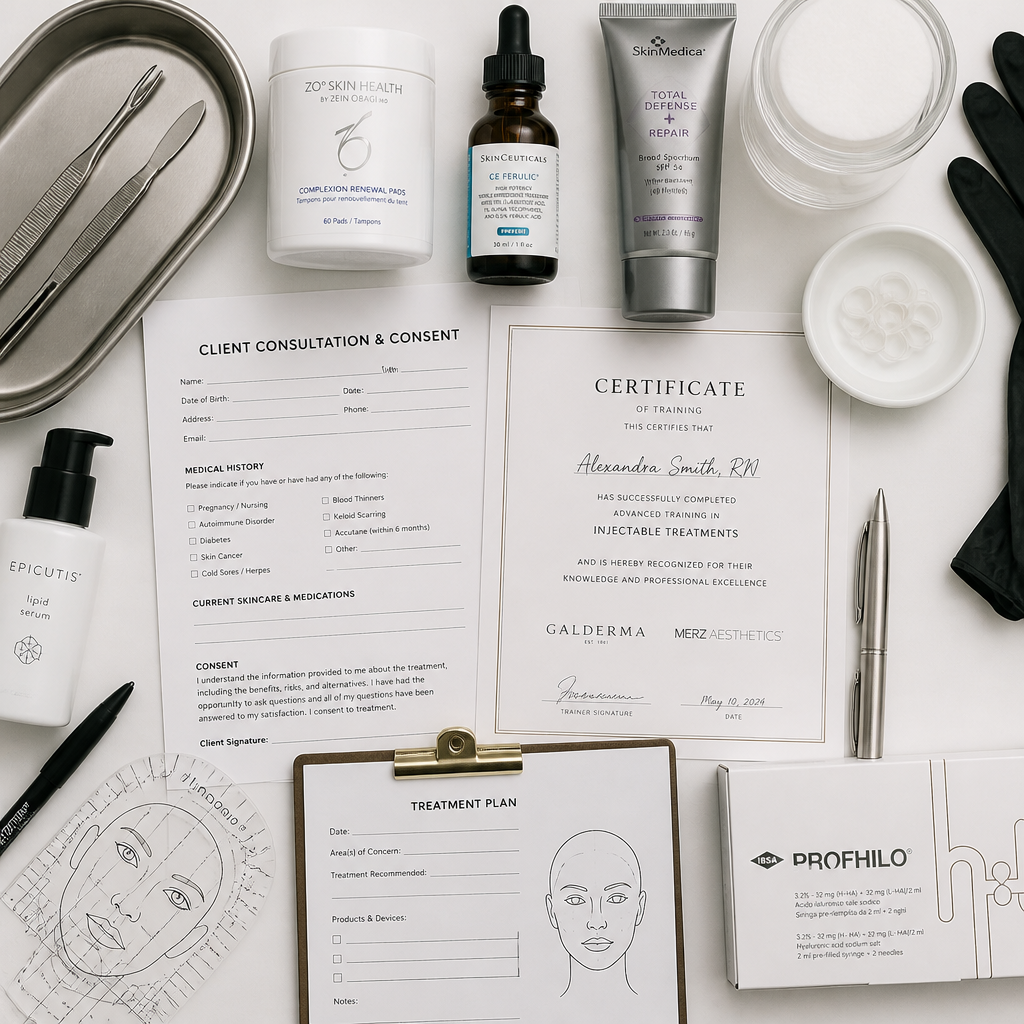
Ontario law is specific about this. The College of Physicians and Surgeons of Ontario (CPSO) requires that medspas operating as out-of-hospital premises have an approved medical director who takes genuine responsibility for clinical compliance. The College of Nurses of Ontario (CNO) draws a parallel distinction: a direct clinical order is client-specific, while a standing directive applies to defined groups of appropriate clients under defined conditions. Both structures require active physician or NP involvement, not a name on a framed certificate.
The practical question to ask is: “Is your medical director involved in day-to-day clinical decisions, and can I reach them if I have a concern after my treatment?” A clinic where the medical director is genuinely engaged will answer this confidently. One where the director is a silent compliance figure will not.
Why this matters for your safety
Medical oversight is not bureaucracy for its own sake. It determines whether there is a qualified clinician who has reviewed treatment protocols, trained staff on managing adverse events, and established a chain of accountability if something unusual happens to you. That structure protects you before, during, and after treatment.
A medical director who exists only on paper is not a safety net. Real oversight means a practitioner who has reviewed your chart, approved the treatment plan, and is reachable when you have a question at 9 p.m. the day after your appointment.
What Does the Consultation Process Look Like?
A proper consultation is not a sales call. It is a clinical assessment. The practitioner should review your health history, ask about current medications (several interact with injectables and laser treatments), discuss your specific skin concerns and aesthetic goals, and explain what is realistic and what is not. That last part matters most.
A practitioner who tells you a treatment is not right for you at this time is showing you exactly the kind of clinical judgment you want performing procedures on your face. A practitioner who agrees to everything you ask without pushback or qualification is not demonstrating expertise. They are demonstrating eagerness to book you.
What a good consultation covers for Aurora-area patients
For treatments like Botox, dermal fillers, Sculptra, Belkyra, or micro-needling, the consultation should cover your treatment history, any prior reactions, your current skincare routine, and an honest discussion of realistic outcomes. For laser hair removal and energy-based treatments, your skin type, Fitzpatrick classification, and any recent sun exposure are all clinically relevant inputs that should be gathered before any device touches your skin.
Pro tip: Book your first consultation as a standalone appointment, separate from any treatment. A clinic that insists on booking both on the same day before you have had time to think is prioritizing their schedule over your decision-making.
What Products and Brands Are Being Used?
Transparency about the specific products a clinic uses is a direct indicator of professional confidence and patient respect. Ask the name of the Botox product (Health Canada approves specific brands including onabotulinumtoxinA formulations), the filler brand and range, and the devices used for laser or energy-based treatments.
A clinic that cannot or will not name the specific injectable product raises a serious concern. Unusually low pricing on injectables, particularly when the discount cannot be explained by a promotional period or introductory offer, can indicate the use of products that have not been approved by Health Canada for use in Canada. Those products may have unverified provenance, incorrect dilution, or unknown storage history.

The brand question applied to devices
The same principle applies to laser and energy-based equipment. Ask the brand and model of the device being used for your laser hair removal or skin rejuvenation treatment. Medical-grade devices are regulated and cleared by Health Canada. Consumer-grade or uncertified equipment marketed with clinical-sounding language does exist in the market. Knowing the device name lets you verify it independently.
What Happens If Something Goes Wrong?
Aesthetic treatments carry real clinical risk. Bruising and swelling are common and expected. Rare but serious complications including vascular occlusion from filler, infection, or unexpected reactions to laser also exist. A clinic that handles this question confidently, with a clear protocol, is demonstrating exactly the kind of clinical maturity you want in a provider.
Ask: “What is your process if I have a concern or reaction after my appointment?” The answer should include a direct contact method for your treating practitioner, a clear escalation path to the supervising physician or NP, and some indication that the clinic maintains appropriate emergency supplies (hyaluronidase for dissolving certain fillers, for instance, is a standard safety supply at any clinic performing hyaluronic acid injections).
After-care follow-up as a quality signal
Clinics that schedule a follow-up contact or appointment after treatments like Botox, PRP/PRF, or micro-needling are not just being thorough. They are demonstrating that their clinical accountability does not end when you walk out the door. That follow-through is one of the clearest signs that a clinic operates like a medical practice rather than a retail service.
How Clinic Types Compare on These Standards
Not all clinics presenting as medspas operate at the same clinical standard. The table below shows how three common clinic models typically compare across the questions raised in this article. Use it as a framework when evaluating your options in Aurora and the broader GTA.
| Evaluation Criterion | Full Medical Aesthetic Clinic | RN-Led Injectable Boutique | Aesthetics-Only Day Spa |
|---|---|---|---|
| Performs injectables (Botox, fillers) | Yes, under physician or NP supervision | Yes, under medical directive from MD/NP | No, not legally permitted in Ontario |
| Medical director involvement | Active and on-site or readily accessible | Present via directive structure, not always on-site | Not applicable or absent |
| Consultation depth before treatment | Full clinical assessment, health history review | Clinical intake, usually thorough for injectables | Limited to skincare goals and preference |
| Product transparency | Full brand and product disclosure standard | Typically transparent for injectables | Skincare product labels visible; no injectables |
| Complication protocol | Documented, includes escalation to physician | Protocol in place, escalation to supervising MD/NP | Limited to minor reactions; no injection protocols |
| Range of advanced treatments | Injectables, laser, PRP/PRF, body treatments | Injectables, sometimes light energy-based | Facials, peels, waxing, basic skin treatments |
Is Pricing Transparent and Honest?
Pricing transparency is about more than knowing what you will pay. It is a window into how a clinic thinks about you as a client. Reputable clinics in Aurora provide a clear per-unit or per-session breakdown for treatments like Botox (charged by the unit), detailed package inclusions for multi-session laser plans, and honest estimates tied to your specific anatomy and goals, not a generic menu price.
Ask for pricing in writing, even if only by email after your consultation. A clinic that resists putting numbers in writing, or that quotes you very different figures on the phone versus in person, is not operating with the transparency you deserve. Transparency about dosing units for Botox is a particular signal to watch for: a clinic that tells you how many units they plan to use and what each unit costs is a clinic that respects your ability to make an informed decision.
When a deal is genuinely a deal versus a warning sign
Seasonal promotions and introductory offers at a credentialed clinic are legitimate. Rock-bottom pricing with no explanation, particularly on injectables, is not. The cost of authentic Health Canada-approved products has a floor. Pricing well below that floor raises a reasonable question about what exactly is being used. Your face is not the place to discover the answer to that question.
Red Flags to Watch for Before You Book
After asking the six questions above, a few specific patterns should end your search for a particular clinic. Staff who cannot name the professional credentials of your treating practitioner, or who become defensive when you ask, have given you an answer even without using words.
Walk-in injection services with no consultation component remove the only clinical safety checkpoint between you and a potential complication. Rushed consultations that feel more like a menu presentation than a clinical assessment serve the clinic’s booking rate, not your safety. And pressure to commit to a treatment package during a first consultation, before you have had time to reflect, is a sales behavior, not a clinical one.
The clinics that are honest at the consultation, including about what they will not do or what is not right for you, are the ones worth trusting with your long-term care. That honesty is harder to fake than a glossy waiting room.
Pro tip: When a friend refers you to a clinic, ask them specifically what they liked about their practitioner’s approach, not just the result. Consistent answers about feeling heard, having questions answered thoroughly, and receiving honest recommendations are the clearest signal that a clinic operates with genuine clinical integrity.
Frequently Asked Questions
What is the difference between a medspa and a regular day spa in Ontario?
A medical spa offers treatments that fall under Ontario’s definition of controlled acts, including Botox injections, dermal fillers, and certain laser procedures. These require licensed medical professionals to perform or supervise. A day spa is limited to non-medical services like facials, waxing, and relaxation treatments. If a spa is offering injectables without a licensed practitioner and medical oversight structure, it is operating outside the law.
Do I need a doctor’s referral to visit a medspa in Aurora?
No referral is required to book a consultation at a medical aesthetic clinic. You can contact a clinic directly, request a consultation, and be assessed by their clinical team. However, the clinic itself should have a physician or nurse practitioner involved in your treatment plan, even if you never meet that person face-to-face.
How do I verify that a nurse at a medspa is licensed in Ontario?
The College of Nurses of Ontario maintains a public register at their official website where you can search any registered nurse or nurse practitioner by name and confirm their license status. This search is free, takes under two minutes, and is the most direct way to verify that the person treating you holds a current, valid license.
Is Botox from a medspa as safe as Botox from a dermatologist’s office?
Safety depends on the practitioner’s training, the product’s authenticity, and the clinic’s protocols, not on whether the setting is a dermatologist’s office or a medspa. A registered nurse at a well-run medspa with proper medical oversight, using Health Canada-approved product, can deliver results that are just as safe. The questions in this article help you confirm those conditions are in place before you book.
What should I bring to a medspa consultation in Aurora?
Bring a list of any current medications and supplements, information about any prior aesthetic treatments (including what product was used if you know it), and a clear sense of what bothers you and what outcome you are hoping for. Photos of results you like can be helpful. Arrive without heavy makeup if possible so your practitioner can assess your skin and facial anatomy accurately.
How many treatments will I actually need to see results?
This depends entirely on the treatment and your individual starting point. Botox typically shows results within days and is maintained with sessions every three to six months for most patients. Micro-needling and PRP therapies usually involve a series of sessions spaced weeks apart. Laser hair removal requires multiple sessions tied to your hair growth cycle. Any clinic that gives you a single definitive number without first assessing your skin, hair type, and goals is guessing, not advising.
If you have gone through this process recently or are preparing for your first medspa booking in Aurora, share what questions you found most useful, or what surprised you during your consultation.
References
- Ontario medspa compliance checklist covering CPSO medical director requirements and delegation rules
- Eight questions to ask a local medspa before booking any treatment
- How to evaluate and choose a safe, effective medspa including practitioner licensing standards
- Patient rights guide covering medical oversight, product transparency, and consent at medspas
- Overview of medspa services and what to ask when choosing a provider in Aurora